
How to Choose a Leading Lighting Manufacturer?

Choosing a Leading Lighting manufacturer is not simply a matter of comparing prices or browsing polished product photos. A reliable partner must turn specifications into consistent performance, shipment after shipment. Look closely at sample quality, optical design, thermal management, and the clarity of technical documentation. Ask for photometric data, stated color consistency, warranty terms, and production quality checks. Details matter.

Thomas Edison, an electric-lighting pioneer, is often credited with saying, “I have not failed. I've just found 10,000 ways that won't work.” The idea fits supplier evaluation: test a sample before approving a large order. Run it for extended periods. Check heat around the driver, inspect finishes under ordinary room light, and compare measured output with the product sheet. A neat showroom sample can hide uneven color or loose connectors. Small clues.

This guide explores how to assess manufacturing experience, product range, customization, quality control, delivery capability, and after-sales support. It also explains which questions can reveal gaps before they become costly project delays. Review certificates and test reports for the specific product and market; do not assume one document covers every model. Speak with recent customers when possible, and ask how the manufacturer handled a defect—not only how smoothly the first order went. The process is imperfect; supplier claims can be difficult to compare, and one successful sample proves little. Still, careful checks make the choice more grounded. A Leading Lighting partner should welcome precise questions and provide clear, consistent answers.
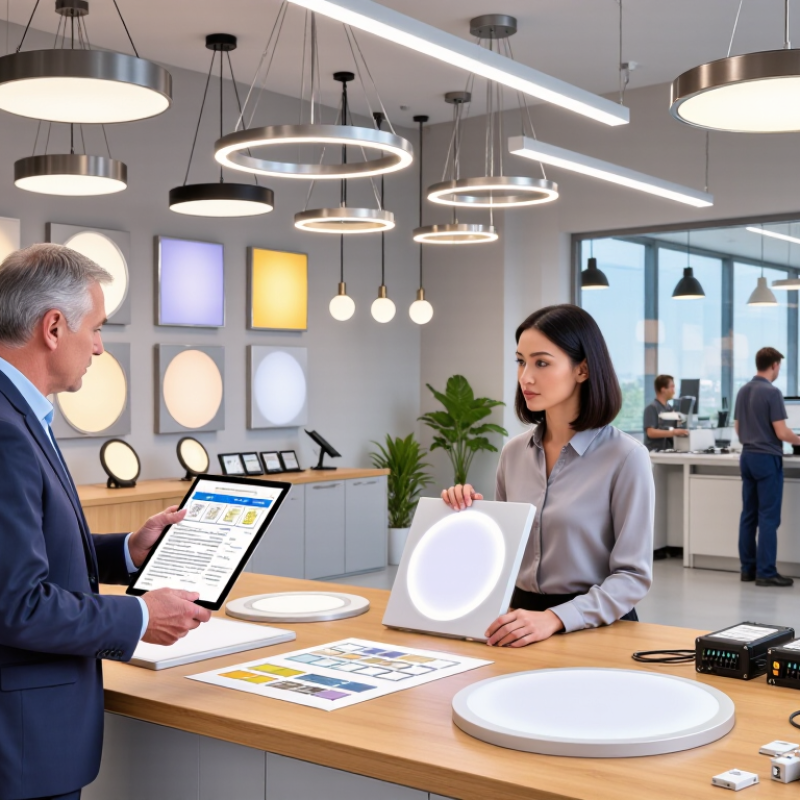
How to Choose a Leading Lighting Manufacturer?

Define Your Lighting Needs and Project Requirements

How to Choose a Leading Lighting Manufacturer?
Define Your Lighting Needs and Project Requirements

A useful supplier conversation starts with a clear project brief, not a catalogue. Record each space’s dimensions, ceiling height, surface colors, and main tasks. A kitchen worktop needs different lighting from a hotel corridor. Note target illuminance, preferred color temperature, color-rendering needs, and whether beams should be narrow or wide. Small details matter. If plans are incomplete, mark assumptions rather than treating guesses as fixed requirements.

List operating conditions too: indoor or outdoor use, moisture, dust, temperature changes, daily run hours, and cleaning routines. These details help identify suitable protection ratings, materials, and maintenance needs. Specify controls, such as dimming or occupancy sensing, and check compatibility with existing wiring. Include mounting constraints, delivery phases, and who will install and service the system. Request photometric files, test reports, warranty terms, and clear product data before comparing proposals. Measure twice. Replacement access is easy to overlook; even a suitable fitting can be difficult to maintain if a ladder cannot reach it. Some requirements may change after a site visit, so leave room to revise the specification.

Define Your Lighting Needs and Project Requirements

Typical maintained illuminance planning benchmarks by space type (lux)

Use these benchmarks to start defining project requirements. Final targets depend on the specific task, applicable standards, room conditions, and maintenance plan.

Assess the Manufacturer’s Product Range and Technical Expertise

A leading lighting manufacturer should offer more than a wide catalogue. Check whether its range covers indoor, outdoor, task, and architectural applications, with clear options for beam angle, colour temperature, control, and mounting. This matters on site: a narrow-beam fitting may create bright patches on a warehouse floor, while a poorly matched dimmer can cause flicker. The U.S. Department of Energy’s 2017 report, Energy Savings Forecast of Solid-State Lighting in General Illumination Applications, projected that widespread LED adoption could save about 569 terawatt-hours of electricity annually by 2035. That figure is a projection, not a guarantee for every project. Details matter.

Technical evidence helps separate capable suppliers from catalogue sellers. Ask for photometric files and LM-79 test reports to verify light output, distribution, and electrical performance. For lifetime claims, review LM-80 data and the method used to project lumen maintenance; a headline lifespan alone says little about heat, driver quality, or operating conditions. Can the manufacturer explain how a luminaire performs in a hot ceiling void or beside a cold loading bay? Good answers should include test conditions and limitations. I would also ask for samples and compare measured output with the project’s needs. Paper specifications can look tidy. Reality is less tidy. A broader range is useful only when supported by consistent testing, practical engineering support, and honest documentation.

Verify Quality Standards, Safety Certifications, and Testing

A leading lighting manufacturer should be able to show how quality is controlled, not just describe it. Ask for the quality-management standard used at the factory, and check that its scope covers the products being quoted. ISO 9001, for example, addresses management systems; it does not certify a lamp’s electrical safety. Safety certificates should match the exact model, voltage, driver, and construction. Verify certificate numbers with the issuing organization, since similar-looking products may have different test results. Requirements also vary by market.

Request recent test reports from a qualified independent laboratory. Check the sample description, test date, and measured results—not only the cover page. Useful checks can include insulation and grounding, temperature rise, ingress protection where relevant, flicker, and lumen maintenance. The details matter. A tidy report does not prove every production batch matches the tested sample. Ask how the manufacturer controls component substitutions, records inspection results, and handles failed units. If answers are vague, request a sample and compare its labels and construction with the documents. Paperwork can be incomplete; that is worth questioning, not ignoring.

How to Choose a Leading Lighting Manufacturer? - Verify Quality Standards, Safety Certifications, and Testing

Evaluation Area Relevant Standard or Evidence What to Verify Good Evaluation Signal
Quality management ISO 9001 quality management system certification Check the certificate’s validity, site coverage, and scope. Confirm that the scope covers the activities relevant to the product, such as design or manufacture. The certificate is current and its stated scope and site match the supplier and product being evaluated. ISO 9001 concerns a management system; it is not a product safety approval.
Luminaire electrical safety IEC 60598 series Request test documentation for the specific luminaire model and confirm that its construction, rated voltage, protection class, and intended use match the proposed product. Documentation identifies the tested model and applicable requirements, with no unexplained differences between the report and the supplied product.
LED module safety IEC 62031 For luminaires using LED modules, check whether the module’s safety evaluation applies to the exact module and operating conditions used. The module documentation is traceable to the installed component and is consistent with the luminaire’s design and ratings.
Controlgear safety IEC 61347 series Review safety evidence for the LED driver or other controlgear, including model identification and relevant operating ratings. The evidence covers the controlgear actually supplied and its intended use within the luminaire.
Photobiological safety IEC 62471 Request an assessment for the relevant light source or product configuration and check that the assessment reflects its intended operating conditions. The report identifies the evaluated product or light source and states the applicable photobiological risk classification or findings.
Ingress protection IEC 60529 (IP code) Confirm the claimed IP rating and check that testing covered the complete luminaire in the configuration being offered, including relevant covers, seals, and cable entries. The rating is supported by product-specific evidence and is appropriate for the installation environment.
Impact protection IEC 62262 (IK code) Where mechanical impact resistance matters, verify the claimed IK rating and the tested product configuration. The test result corresponds to the offered model and supports the impact-resistance requirement for the project.
Photometric performance IES LM-79 test method Request a photometric test report for the complete solid-state lighting product. Review measured light output, electrical input, and efficacy alongside the test conditions. Results are traceable to the tested model and configuration, and the report’s measurements are suitable for the intended comparison.
LED lumen maintenance IES LM-80 measurements and IES TM-21 projections Distinguish measured LED package, array, or module maintenance data from projected values. Check that the projection uses applicable LM-80 data and states its assumptions. Claims clearly identify whether values are measured or projected and do not present a projection as a direct lifetime test of the complete luminaire.
Electromagnetic compatibility Applicable EMC requirements and test reports for the target market Confirm which emissions and immunity requirements apply to the product and destination market. Review reports for the exact model or a documented representative configuration. Evidence covers the relevant market requirements and identifies the tested equipment and configuration.
Certification and market access Certificates, declarations, and market-specific conformity records Check issuer, certificate number, validity, product scope, model coverage, and destination-market applicability. Treat a manufacturer’s declaration of conformity as distinct from independent product certification. Documents are current, verifiable with the issuing organization where applicable, and clearly cover the supplied product. A conformity mark alone is not a substitute for supporting documentation.
Production consistency Incoming inspection, in-process controls, final inspection, and traceability records Ask how component changes are controlled, how batches are identified, and how production units are checked against approved specifications. The supplier can show documented controls and traceability linking supplied units to their production and inspection records.

Note: Applicable requirements depend on the product type, installation, and destination market. Verify the current editions and local regulations for the project. Test reports and certificates should be checked for model coverage, scope, validity, and configuration—not just for the presence of a standard number.

Review Customization Options, Production Capacity, and Delivery

A leading lighting manufacturer should offer customization that fits the project, not just a long options list. Ask whether it can adjust wattage, beam angle, color temperature, housing dimensions, and finish. Request a physical sample before approving a large order. A warm-white sample under showroom lights may look different in a hotel corridor. Details matter.

Review technical records alongside the sample. Photometric data, thermal test results, and clear drawings help confirm that a proposed fixture suits the application. Ask how design changes are documented and who approves them. I would also check whether the manufacturer can produce a small pilot batch; it can reveal fit or finish issues before full production. Not every supplier will welcome this step, and that hesitation is worth discussing.

Production capacity needs evidence, not confident estimates. Ask about current equipment, staffing, component sourcing, and monthly output for the specific product type. A factory may have impressive total capacity but limited space in its schedule. Request a realistic production timeline, including inspection and packaging. Confirm how delays are communicated and what happens if a component arrives late. Shipping estimates should specify the destination, packing method, and handoff date. Leave room for uncertainty; even a careful plan can miss a detail.

Compare Customer Support, Warranty, and Long-Term Value

When choosing a lighting manufacturer, compare the support you can actually reach, not just the promises on a product page. Ask how quickly technical questions are answered and whether staff can help check dimmer compatibility, mounting details, or replacement parts. A clear reply with a wiring diagram is more useful than a polished sales pitch. Test the process before ordering. Send one specific question and note how long the answer takes.

Tips: Request the warranty in writing. Check its term, covered components, exclusions, and claim steps. Ask who pays shipping for a failed driver or fixture, and whether replacement parts will remain available. Keep the reply with your project records.

Long-term value includes more than the initial price. Compare expected service life, energy use, maintenance access, and the effort required to replace a component in a ceiling or display case. Ask for performance data and suitable installation conditions. A low-cost fixture can become expensive if support is slow or repairs require replacing the whole unit. I would not treat any estimate as a guarantee; real operating hours and installation conditions vary. Leave room to revise your assumptions, especially when planning for a large space or a long service period.