
2026 Top LED Lighting Manufacturers for Global Buyers
Choosing a global LED lighting manufacturer is not just a price comparison. Buyers need dependable performance, clear technical documentation, and support after delivery. This guide to 2026’s leading manufacturers examines product range, energy efficiency, color consistency, thermal design, controls, warranty terms, and manufacturing capability. Small details matter.
Nobel laureate Shuji Nakamura, whose work helped make efficient blue LEDs possible, described the technology as “a very important invention for humankind.” That achievement now shapes lighting in warehouses, offices, streets, retail spaces, and homes. Yet a strong product sheet does not guarantee a good project outcome. Buyers should also check test reports, sample performance, replacement-part availability, and communication across time zones.
The manufacturers featured here serve different needs. Some focus on high-volume commercial fixtures; others specialize in architectural systems, industrial high bays, or connected lighting. Comparing them fairly means looking beyond headline efficacy. Verify the stated lumen output, color temperature, dimming compatibility, and warranty conditions against project requirements. Details can change.
This overview is a practical starting point, not a permanent ranking. Product lines, lead times, and service quality can shift during the year, and public information may not show every weakness. That limitation matters. Request current documentation and test representative samples before making a major purchase. Even careful buyers can miss something. A site visit or independent assessment may reveal what a catalogue cannot.
How the Global LED Lighting Market Is Structured in 2026
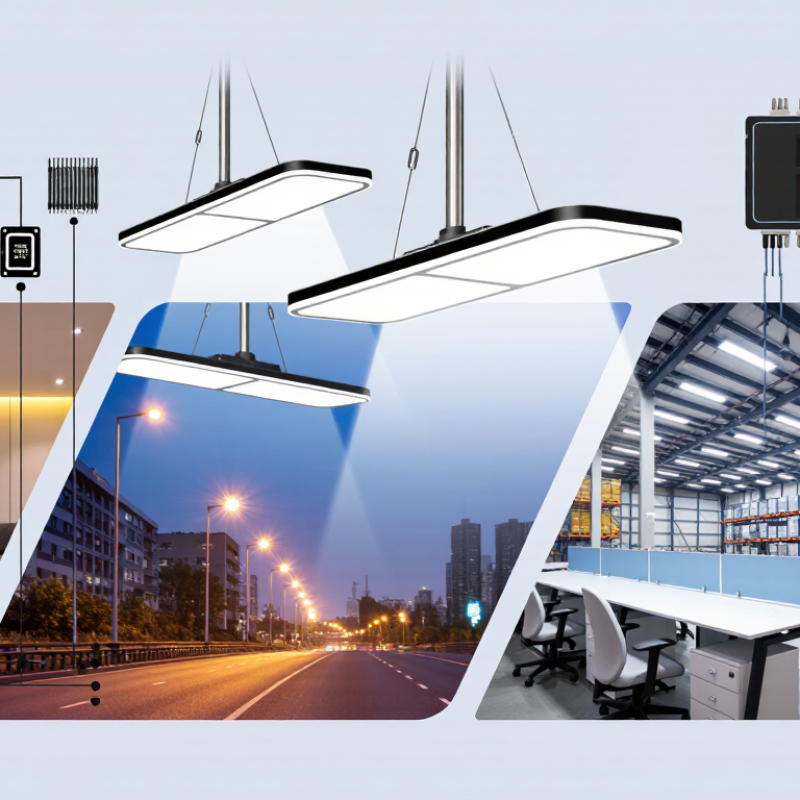
In 2026, the global LED lighting market is organized around more than finished fixtures. Upstream suppliers provide LED packages, drivers, optics, heat sinks, and control components. Manufacturers combine these parts into products for homes, offices, streets, warehouses, and specialist settings. Some operate their own production lines; others rely on contract factories for assembly or selected components.
The market also divides by service and sales model. Project-focused producers may tailor beam angles, housing materials, dimming, or control interfaces to a building specification. Volume suppliers often prioritize repeatable designs, stable lead times, and straightforward installation. Between them are distributors and lighting contractors, who influence which products reach a site and how they are commissioned. A buyer comparing quotations should check more than lumen output: photometric files, driver details, warranty terms, and test documentation can reveal meaningful differences.
That picture is useful, but not complete. Supply chains can shift, and product consistency may vary between batches, even when the catalogue looks polished. A practical review includes sample testing, clear change-control records, and direct questions about component sourcing. For a warehouse project, for example, glare control and replacement access may matter as much as headline efficiency. Global buyers also need to match product specifications and certifications to the destination market, rather than assume one configuration fits every region.
What Makes an LED Lighting Manufacturer a Leading Global Supplier
A leading LED lighting manufacturer is not defined by production volume alone. It must turn project requirements into products that perform consistently across different climates and electrical systems. Buyers should review photometric data, thermal design, test reports, and documented quality controls. Ask how performance is checked from the first sample through repeat production. Small details matter.
A warehouse fixture may look bright in a showroom yet overheat above a loading dock. A capable supplier explains lumen maintenance, driver options, ingress protection, and installation limits in plain language. It should also provide realistic lead times, clear packaging specifications, spare-part support, and responsive technical communication across time zones. A polished catalogue helps, but it is not proof.
Global supply depends on consistency, but no factory can remove every project risk. Buyers need sample approvals, traceable batch records, and a clear process for investigating failures. Request evidence relevant to the intended application rather than broad promises. There is a trade-off. Custom fixtures can solve site-specific problems, but may extend testing and delivery schedules. Even experienced teams sometimes overlook glare or mounting access until installation. It is better to discuss those limits early.
| Evaluation Dimension | Practical Buyer Benchmark | Why It Matters | Evidence to Request |
|---|---|---|---|
| System luminous efficacy | Compare delivered luminaire efficacy in lm/W; a procurement target of 130 lm/W or higher can be useful for many general-purpose commercial applications. | Higher efficacy can reduce energy use for a given light output. Compare complete-luminaire data, not LED-chip figures alone. | Photometric test report, rated input power, delivered lumens, and the test conditions used. |
| Color quality | CRI (Ra) of at least 80 is a common baseline for general indoor applications; consider 90 or higher where more faithful color rendering is needed. | Color quality affects how people and objects appear under the light. The appropriate level depends on the space and task. | Color-rendering data, including CRI and, where relevant, R9 or IES TM-30 results. |
| Correlated color temperature (CCT) | Specify the required CCT in kelvin, commonly selected from ranges such as 2700 K, 3000 K, 4000 K, and 5000 K. | Consistent CCT supports the intended atmosphere and helps maintain a uniform appearance across a project. | Product datasheet, available CCT options, and color-consistency or binning information. |
| Color consistency | Set a project-specific tolerance; a 3-step MacAdam ellipse or tighter is a common specification for projects requiring close visual matching. | Tighter tolerances can reduce visible color variation between luminaires and production batches. | Chromaticity coordinates, binning policy, and confirmation that supplied batches meet the specified tolerance. |
| Driver and electrical performance | Check input voltage and frequency for the destination market. For many commercial projects, specify power factor ≥0.90 where applicable. | Electrical compatibility and power quality requirements vary by market, application, and local regulation. | Driver datasheet, electrical test reports, dimming compatibility information, and applicable market approvals. |
| Ingress protection and construction | Select the IP rating for the installation environment: for example, IP20 for dry indoor areas or an appropriate higher rating for exposure to dust or water. | The right enclosure protection helps match the luminaire to its location; an IP rating does not by itself establish impact resistance or corrosion resistance. | Test documentation against IEC 60529, plus separate impact or corrosion test evidence when required. |
| Safety and photobiological assessment | Require compliance with the safety rules and product standards applicable in the destination market, including relevant luminaire and LED photobiological safety requirements. | Requirements depend on product type and market. Standards commonly referenced include IEC 60598 and IEC 62471. | Valid declarations, test reports, certification records where required, and clear model-to-document traceability. |
| Lifetime and lumen maintenance | Review the stated lifetime and the method behind it; request an L70 projection supported by LM-80 data and TM-21 calculations where applicable. | LM-80 test data and TM-21 projections relate to LED-source lumen maintenance; they are not, on their own, a complete guarantee of luminaire service life. | Relevant LM-80 reports, TM-21 calculations, operating-temperature assumptions, and warranty terms. |
| Warranty and after-sales support | Compare written warranty coverage, duration, exclusions, and remedy. A five-year warranty is a common commercial procurement benchmark, not a universal requirement. | Clear terms and accessible technical support can reduce replacement delays and project risk. | Warranty document, claims process, spare-parts policy, response-time commitments, and regional support arrangements. |
| Supply capability and traceability | Confirm production capacity, agreed lead times, batch consistency, and the ability to identify products by model and production lot. | Reliable delivery and traceable records are important for multi-site projects, repeat orders, and quality investigations. | Capacity and lead-time records, quality-control process, sample batch labels, and change-notification procedures. |
Major LED Lighting Manufacturers and Their Areas of Specialization
LED manufacturers usually specialize by operating environment, not simply by lumen output. Commercial-lighting suppliers serve offices, schools, and retail spaces, where glare control, color consistency, and dimming matter. Their panels and linear fixtures should light desks evenly without harsh reflections. Small details matter. Industrial specialists make high-bay and sealed luminaires for warehouses, food plants, and loading areas. Buyers can compare thermal management, ingress protection, driver replacement, and warranty terms. The U.S. Department of Energy reports that LEDs use at least 75% less energy and may last up to 25 times longer than incandescent lighting. That benchmark is useful, but it does not guarantee the same results for every fixture or operating schedule.
Outdoor specialists focus on optics, corrosion resistance, and controls for roads and parking areas. Horticultural suppliers tune light spectra for crop growth; automotive manufacturers prioritize compact optics and vibration resistance. Different jobs. The International Energy Agency estimates that lighting accounts for about 15% of global electricity use. Efficiency matters, but poor optical design can still waste light. Request photometric files and relevant LM-79 or LM-80/TM-21 test evidence, then check that it matches the offered model. One limitation remains: published efficacy cannot show how easily a fixture is serviced or how its controls perform on site.
2026 Top LED Lighting Manufacturers for Global Buyers
Major LED lighting specializations and indicative product efficacy ranges
The chart compares common LED product specialties by indicative luminous efficacy in lumens per watt (lm/W). Ranges are representative, not universal manufacturer specifications; actual performance varies with product design, color temperature, color rendering, and operating conditions.
How to Compare Manufacturers for Different Lighting Applications
A manufacturer should be compared against the job, not just the price per fixture. For warehouses, check delivered lumens, glare control, and performance at high mounting heights. Retail spaces need dependable color rendering and consistent color between batches. Road and outdoor projects call for verified beam distribution, weather resistance, and suitable surge protection. The 2024 Global Status Report for Buildings and Construction estimates that buildings used 32% of global energy in 2023. Efficient lighting matters, but only when its measured output suits the space.
Ask for independent LM-79 photometric test reports and clear details on driver, controls, and warranty. For long-life claims, review LM-80 data and the related TM-21 projection; these are not a promise that every complete fixture will last that long. Compare sample units under real operating conditions when possible. Spec sheets can flatter. A small detail, such as dimming flicker or a poor lens, may only show up after installation.
Tips: Match the test evidence to the application. For a high-bay sample, check light levels at the floor and between aisles. For a streetlight, review the actual photometric file, not just the lumen figure. Record any gaps in the supplier’s documentation; they deserve a follow-up, not an assumption.
What Global Buyers Should Check Before Selecting a Supplier
Before selecting an LED lighting supplier, check whether its test reports match the exact product model you plan to order. Ask for independent photometric and electrical test results, plus LM-80 and TM-21 documentation where relevant. Confirm that the quoted beam angle, color temperature, lumen output, and ingress protection match your project requirements. A sample can look convincing under a showroom ceiling. Test it in the actual installation conditions, too.
The International Energy Agency’s Energy Efficiency 2019 report estimated that lighting used about 15% of global electricity and produced roughly 5% of global greenhouse gas emissions. Efficiency claims therefore deserve careful scrutiny. The U.S. Department of Energy says LED bulbs use at least 75% less energy and last up to 25 times longer than incandescent bulbs. Those figures are broad comparisons, not guarantees for every fixture. Compare measured efficacy, warranty exclusions, driver availability, and replacement lead times. Ask how production batches are traced and how defects are handled. I would still question a supplier whose paperwork is perfect but whose answers about spare parts are vague.
Related Posts
-
Top 10 LED System Suppliers in China for Global Buyers
-
How to Choose the Best Led Lighting for Cost Efficiency and Sustainability in Global Markets
-
Discover the Future of Home Illumination: How LED Lighting Transforms Your Living Space
-
How to Choose the Right Led Lighting System for Your Home
-
2026 Top Led Lighting System Innovations You Need to Know?
-
Top 10 Led Bulbs for Global Buyers in 2026?