

7 Sidewalk Lighting Tips for Global Buyers
Sidewalk Lighting shapes how people read a street after dusk. A bright storefront, a tree canopy, or a wet paving stone can change what a fixture needs to do. For global buyers, the challenge is not simply choosing the highest lumen output. It is matching light distribution, mounting height, durability, controls, and maintenance to the actual site. Small details matter. A beam that spills into nearby windows may create complaints, while deep shadows near a curb can make a path feel uncertain.
This guide shares seven practical tips for evaluating products and suppliers across different markets. It covers photometric data, color quality, weather resistance, energy use, installation conditions, and lifecycle support. Ask for test reports and clear specifications, then compare them against the project’s local requirements and site plan. A catalog image is not enough. If possible, review a sample or mock-up at night, when glare and dark patches become easier to spot. No single fixture suits every sidewalk, and published ratings do not replace careful project review. Supplier support matters too, especially when replacement parts or controls differ by region. Even experienced buyers can overlook trees that will grow, or crews who need room to service a pole. That is worth admitting. The right choice is practical, verifiable, and suited to the people who use the route every day.
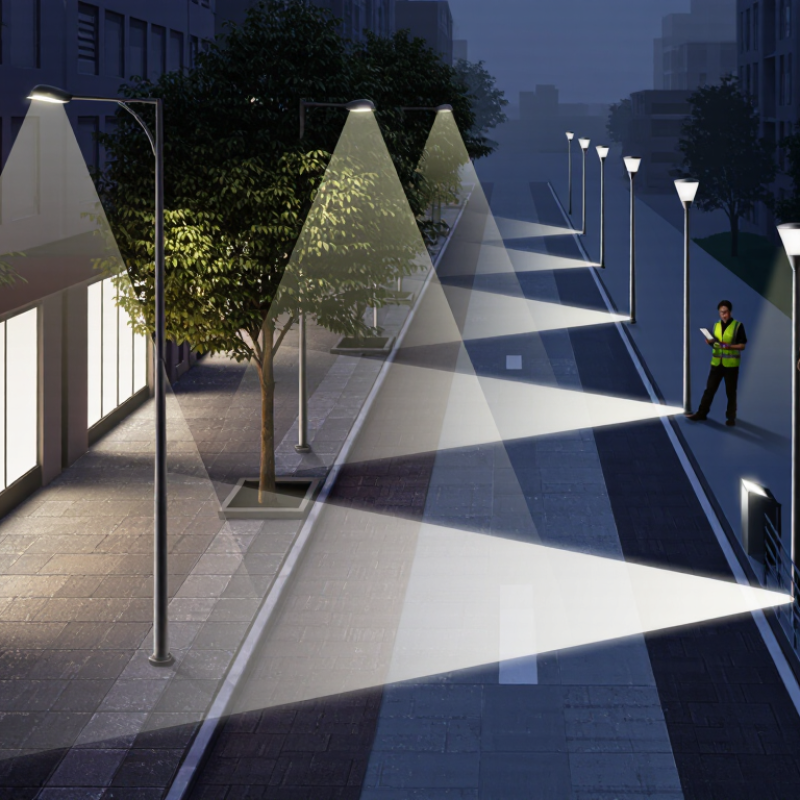
Table of Contents
[Hide]
Assess Sidewalk Layout, Pedestrian Flow, and Local Conditions
Before choosing sidewalk lighting, map the route as people use it, not merely as it appears on a site plan. Note curb ramps, crossings, bus stops, benches, trees, and narrow sections. Walk it at dusk. A row of evenly spaced poles may look orderly, yet leave a dark patch beside a tree or shelter. Record where pedestrians pause, turn, or cross, and check whether doors or signs create temporary obstructions.
Pedestrian flow affects both light levels and placement. A busy station approach may need more consistent illumination than a quiet path, while intersections deserve clear visibility of faces, curbs, and approaching movement. Review mounting height, spacing, and beam direction together; changing one can create glare or deep shadows elsewhere. A simple nighttime walk-through can reveal what a drawing misses. Still, one visit is not enough: seasonal foliage, delivery activity, and evening events can change how a space feels.
Local conditions should shape material and optical choices. Frequent rain can produce reflective pavement, while coastal air may speed corrosion and winter maintenance may expose fixtures to snow or equipment. Check local weather patterns, maintenance access, and applicable municipal guidance with an experienced local professional. Even a careful assessment has limits. An attractive layout can still feel uncomfortable if light shines into nearby homes, so review the design from the sidewalk and adjacent windows before finalizing it.
7 Sidewalk Lighting Tips for Global Buyers - Assess Sidewalk Layout, Pedestrian Flow, and Local Conditions
| Assessment area | What to measure or check | Planning guidance | Lighting response |
|---|---|---|---|
| 1. Sidewalk layout | Map clear walking width, curves, crossings, entrances, steps, ramps, and obstacles. | Record the usable pedestrian route in metres. Check local accessibility rules; required clear widths differ by jurisdiction. | Place and aim luminaires to reveal the full route and changes in level without obstructing the accessible path. |
| 2. Pedestrian flow | Count pedestrians during representative peak and off-peak periods; note queues and crossing movements. | A 15-minute count multiplied by four gives an hourly rate for that observation period. Use more than one time period where demand varies. | Give bus stops, transit approaches, busy crossings, and queuing areas particular attention to visibility and even light distribution. |
| 3. Illuminance targets | Review maintained horizontal illuminance on the walking surface and vertical visibility at faces and crossings. | Use the applicable local lighting standard and project risk assessment to set lux targets; there is no single target suitable for every sidewalk. | Request a photometric calculation using actual mounting height, spacing, optics, surface conditions, and maintenance assumptions. |
| 4. Uniformity and visual comfort | Check for dark gaps, abrupt bright-to-dark transitions, direct view of bright sources, and reflections. | Assess minimum and average illuminance together, not average illuminance alone; apply the uniformity and glare criteria required locally. | Adjust spacing, optics, shielding, and aiming to limit glare and keep light on the pedestrian route. |
| 5. Climate and exposure | Identify expected temperature range, heavy rain, snow or ice, wind, dust, salt spray, and flood exposure. | Compare site conditions with the luminaire’s documented operating temperature and ingress-protection rating; specify corrosion resistance for the environment. | Select suitable enclosures, materials, seals, and mounting details, and plan access for cleaning and maintenance. |
| 6. Nearby residents and ecology | Check bedroom windows, property boundaries, trees, waterways, and any local limits on upward or spill light. | Confirm local curfews, environmental requirements, and permitted light levels before finalizing the design. | Use cutoff optics, careful aiming, and dimming schedules where permitted to reduce unwanted light beyond the sidewalk. |
| 7. Power, controls, and maintenance | Check supply voltage and frequency, metering, control compatibility, pole access, and the available maintenance plan. | Confirm electrical and product-safety requirements for the destination market; estimate energy use from input watts, operating hours, and control schedules. | Specify compatible drivers and controls, surge protection where required, replaceable components, and a practical inspection and cleaning interval. |
Planning note: Values and product requirements should be verified against the project’s local codes, lighting standards, climate conditions, and a site-specific photometric design.
Related Posts
-
Maximizing After Sales Support and Reducing Maintenance Expenses for Led Fixture Lights
-
Exploring Alternative Solar Street Light Options for Global Buyers
-
2025 Guide: How to Choose the Best LED Spotlights for Your Home
-
How to Choose the Best Lighting for Any Space?
-

Innovative Applications of Best Industrial Lighting in Various Sectors
-
What is the Best Outdoor Lighting Solutions for Your Home?